Gordon & Maureen Morris – Anomalies

If while walking into the gallery you feel as if you have been sucked into a vortex in the space time continuum, then congratulations, you have stumbled across the most entertaining and creative show of the year, Anomalies, by Gordon and Maureen Morris.

Maureen and Gordon Morris met in college where they both graduated from the Ontario College of Art in Toronto.  Gordon started out on a career in graphic design back when the work was all done by airbrush but he soon found himself on the cusp of the early use of computers to produce these images.   He was able to adapt his style to the computer and soon became adept at using a tablet and monitor to draw and paint images.  Because of Gordon’s ability to lead the curve of the new technology he was offered jobs in exotic locations and so he and Maureen lived in Hong Kong, China, New York, Chicago, and Los Angeles where each of their creativity was guided by their experiences and surroundings.  Maureen’s love of ceramics has also taken her to Lill Street Studios in Chicago, Santa Monica College in Los Angeles and other studios along the way.  Studios are shared work spaces where ideas and techniques are exchanged between the various artists.  It was an opportunity for Maureen to learn and to teach and to truly grow professionally.

Gordon’s trip back to fine art came to real fruition after their move to Mexico once he was able to apply his creative talents towards his own, non-commercial creations.  Gordon uses Photoshop to plan out the paintings and develop the characters and subject of his work. If a new idea develops he can then scan the painting into the computer and try out the idea before committing it to the canvas which he does by hand.  Maureen also began exploring her medium to the maximum in Mexico creating geometric and organic ceramic forms (cacti, insects, hearts & functional art) influenced by her environment while incorporating the traditional firing methods in gas and electric kilns as well as pit firing, raku and naked raku techniques.

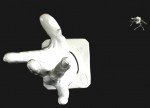
Gordon’s work is highly detailed and usually bizarre in subject. He uses sculptural elements, usually on highly complicated frames, which help to develop further the ideas in the main image.  There is usually some kind of story being told by an interesting nearly literary character.  A highly colloquial adjective that can describe the work is simply “cool”.  A sense of playful fun exudes from the work.  It is interesting how this same playfulness is also exuded by Maureen’s work.  The ceramic medium because of its more rigorous production demands lends itself to more austere expressions, yet Maureen’s work shares Gordon’s language of the light-hearted and the non-conformist.  It only takes a visit to their home and studio to understand some of the influences that help to form their current common language: vintage toys, robots, and other playful paraphernalia found from their travels around the world – items that contest to their status of children at heart and true admirers of both high and low art.

Come be transported to another world and meet the artists this Saturday, August 4 from 6 to 9 PM at POLYGLOT Gallery.   Exhibition will be on display through August 29.  For a PDF catalog of the show please e-mail info@polyglotgallery.com.
PETER LEVENTHAL – New Paintings

Peter Leventhal is a storyteller.  Having had the fortune to be born and raised in New York City with all of its stimulation and access to the greatest artwork of the Western World, Leventhal soaked in every opportunity he was given to learn from the old masters and to mingle with the new.  Primarily a self-taught artist, Leventhal credits the hours he spent in the New York Public Library, which houses drawings of some of the world’s greatest masters where he would copy and learn from their every mark, for the basis of his art’s education.

One of the early painters who peaked Leventhal’s interest was Raoul Dufy, a French Fauvist painter.  It has been nearly 40 years since Leventhal has been inspired by and has conversely interpreted some of Dufy’s philosophies into his own work.  Most recently, he finds that as his physical ability to hold a paintbrush in his dominant hand is no longer an option due to the Parkinson’s, he is now able to more fully embrace Dufy’s concept of allowing color to override the edge and follow into the adjoining figure and not be confined to a spatial context.  This has created more dynamic activity in his newest body of work, which is markedly more abstract than anything Leventhal has previously painted. This marked evolution also includes broader brush strokes and a generalization of the light/dark contrast of the composition as well as a particularization of the color.  The outcome is a series of vivid paintings that reference common Leventhal themes – love, lust, envy, exhibitionism, artistry – and characters – the sculptor, etcher, dice player and accordionist – while offering the viewer a new glimpse into the evolution of his work.

The public is invited for a cocktail reception with the artist on Friday, July 6 from 6-8 PM.  The work will be on exhibit until August 1, 2012.

GALLERY COLLECTIVE – SMALL WORKS


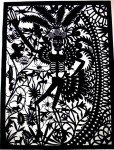
On exhibit for June are some of the favorite works from the past few months.  Come see gouaches by Polly Stark, cut paper by Margarita Fick, photography by Barbara Levine, paper mache sculptures by Edward Swift, ceramic sculptures by Adrian Guerrero, Maureen Gordon, Rodolfo Calva, and Rodrigo Lara, assemblage by Claude Mathey and Zoë Siegel, etching by Luis Carlos Rodriguez Ojeda and a fantastic wall relief by Angelina Perez Ibargüen.

Chuck Rigg – Portraits & Nudes

CHUCK RIGG – PORTRAITS AND NUDES

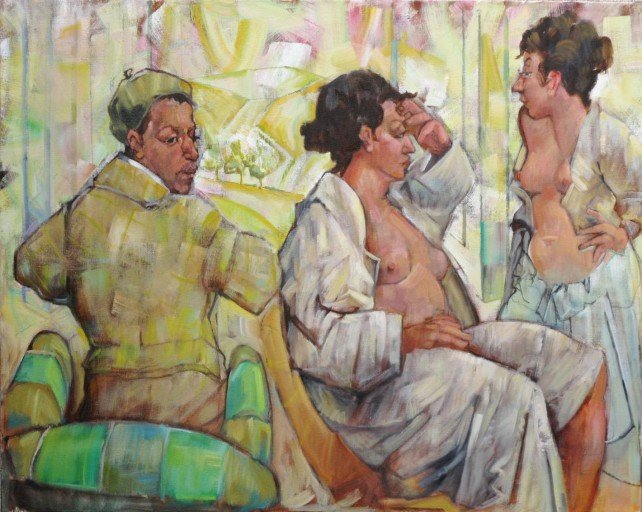
Rigg’s work combines his love for figurative painting with his appreciation of the male figure.   He is a skilled draughtsman as demonstrated by the numerous drawing awards he has won during his career and as is visible in the line of his paintings.  Also visible are the deliberate brushstrokes that are pervasive throughout his body of work.  The expressed influence of Caravaggio, Velasquez, Degas, Matisse, and Richard Diebenkorn come through in many subtle and not so subtle ways.  Many of the backgrounds of his paintings look as if Diebenkorn himself may have painted them during his Ocean Park phase.

Rigg expresses a comfort level with the male form as he feels an intimacy with and an attraction to it that creates a stimulating environment in the studio – sometimes erotic, sometimes fraternal.  Many of his handsome models are from San Miguel and are painted live while posing in the natural light in Rigg’s top floor painting studio.    As a gay male artist painting naked men, he feels he is making some kind of a political and cultural statement which he finds adds another dimension to the choice of subject matter, “growing up gay I always felt outside the mainstream, so painting something which won’t be accepted by everyone just feels normal.”

A young man’s commentary about the Bakker photographs

People from all walks were in attendance at Bakker’s opening and where most people rejoiced in the candid expression the photographer captured from his subjects there was at least one very verbal dissident.  I soaked in his youthful perspective and the opportunity to defend the work.   He was a young photography student named Mario Andrade who was afraid these photos were false in their depiction of how devastating the subject’s lives truly were.  The discussion lasted a good while & I promised him that if he wrote something that I would post it to the blog.

Bueno, Mario, cumplo con mi compromiso.  Ojala algún día serán tus fotografías expuestas en la galería y estaremos discutiendo como te ayudamos a resolver estos graves problemas de desigualdad.

Por Mario Andrade
“Increíblemente, hoy cada día, podemos transitar por las calles de cualquier ciudad de México, con una naturalidad que se ha hecho tan común como respirar, sin mirar que nuestra gente, nuestro pueblo, está padeciendo. Está pereciendo. Se ha plasmado en la memoria de nuestra nación la falsa idea de que “en México no existe la pobreza extrema, ni la esclavitud” pero si usted es un ser sensible y observador, se dará a la labor de reír irónicamente a carcajadas al escuchar semejante declaración.
Como en una copia de diferente papel, en México vivimos un holocausto palpable, donde gente muere todos los días y agoniza lentamente en nuestras avenidas; que también son sus avenidas.
Victimas y presas de un sistema que sirve solo para mantener un diario vivir rutinario, los de clase media y media baja, se dedican a gastar su tiempo en trabajar en una empresa que probablemente los despachará cuando exista un recorte de personal, o cuando estén en tiempo de jubilarse; 8 horas diarias de labores lineales como mínimo; es un círculo vicioso que no para de girar. Al tener la necesidad de alimentar y sustentar una familia, las cabezas al frente, se envuelven en gastos para satisfacer dichas necesidades, trabajo duro, y deudas que se liquidan sólo al recibir la próxima paga.
El tiempo libre y de familia se ha limitado a unas cuantas horas de convivencia, y ¿En qué tiempo queda el sensibilizarse por la sociedad? ¿En qué parte puede un extraño ocupar una prioridad en la existencia de un hombre con estas características?
La necesidad de ver por los propios es la figura y todo lo demás puede englobarse en el fondo.
¿Y dónde queda nuestro pueblo que vive al margen de la escasez y la muerte? En las calles. Sin fin de ancianos y niños se ven forzados a buscar el pan de cada día en una sociedad que los ha materializado en un mismo concepto “el limosnero”. ¿Porqué no se recuerda el rostro de un niño, que un día antes también se acercó a nosotros a pedir un centavo? ¿Será porqué es parte del fondo?
Lector. ¿Alguna vez le has preguntado su nombre a alguna de estas personas? Si es así, te felicito, pues has cruzado una barrera invisible pero casi indestructible. Si no, te invito a plantearte el pensamiento de si esas personas son tan ajenas a ti, tan diferentes a ti. Recuerda que tal vez sea más común saber el nombre de alguien que conociste en un bar o en la parada del autobús. Realmente no considero que sea el contexto de la situación, el pretexto que nos niegue un diálogo.
Puede ser que tenga una quimera en la mente en donde tantos se han postrado, sin parecer haber cambiado resultados, pero ¿que hubiera sido de nuestro mundo, si no existieran personas que seguimos recargándonos en la misma quimera?”

DIRK BAKKER – MANOS

written by: Kahren Jones Arbitman

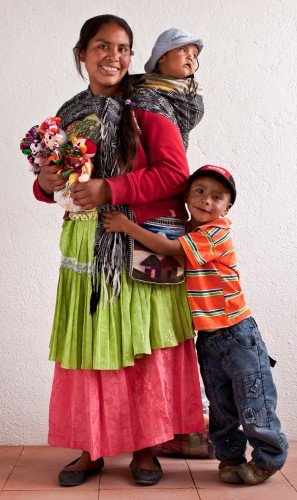
Frequent travelers to and the citizens of Mexico will recognize them all: the wizened crone holding wilting calabaza flowers, the one-legged woman plunking her ukulele, the insistent man hawking rubber maps, the costumed ladies selling beribboned dolls.  These peddlers and panhandlers fill the city’s alcoves, stoops, and walkways, their places staked out by habit, or more likely, by inviolate street rules.  But who are these familiar yet frequently anonymous people who form such an integral part of the culture?   Dirk Bakker, professional photographer and director of photography at the Detroit Institute of Arts, wants to discover if life-sized, color photographs can reveal the personalities of Mexico’s street people.

To help overcome his subjects’ understandable reticence to his proposal, Bakker hires a driver and translator, buys hearty food, and creates a comfortable environment in his studio.  Using natural light, a backdrop of gritty white plaster, and simple floor tiles, he fashions a slightly elevated, non-threatening stage for the self-revealing portraits he hopes to coax from his subjects.  Quietly asking about their lives and families, Bakker waits for each to settle into a pose.  What results are startlingly intimate performances played out in front of the camera: some clown, some stand defiantly, others retreat into a shell.

Then, in what must have been mystifying to his sitters, Bakker lies on the floor and aims his camera directly at their hands.  The choice of focus is quite deliberate; hands are the consistent point of interaction between street people and those who occasionally drop “a little something” into their upturned palms.  By altering the expected focus on faces, Bakker allows his sitters’ hands to lead the storytelling.  And what stories they tell.  Invariably work-worn and often gnarled and arthritic, hands become welcoming, withdrawn, defensive, content.

Another important artistic consideration is Bakker’s lowered vantage point which literally and figuratively elevates his subjects.  In an insightful turnabout, viewers are now confronted by people who loom above them, no longer content to sit with bowed heads awaiting the generosity of strangers.  A similarly important consideration is Bakker’s decision to set aside a telephoto portrait lens that tends to flatten and in many ways flatter the sitter in favor of a “normal” lens that conforms to the angle of human vision.  He is looking for verisimilitude.

While the photographs’ technical virtuosity is undeniable, Bakker does not want digital wizardry or artistic license to overshadow an honest presentation of his sitters.  Fortunately, documentation and artistry can happily coexist in a single photograph. Simultaneous with documenting a life, these images also present a riot of mismatched color, pattern upon pattern, ruffles, fringes, buttons, makeshift belts, and other picturesque details that dazzle the viewer like a well-painted abstraction.  Equally arresting are the piercing expressions of many of the life-sized figures that could easily find prototypes in Diego Velazquez’s haunting, solitary misfits.  Despite the artist’s intent to capture only what his sitters give him, viewers cannot help but mentally embellish the individual stories.  For this writer, one telling detail is an elderly gentleman’s hemmed cuffs that touchingly speak of an attentive caregiver.  It’s nice to know he’s not alone.


Colorful adventures in DF

Call it the 2012 phenomenon but I am changing in ways I never imagined I might change.  Change is the only constant, right?  But in general I thought I would always at least see most changes coming.  These past few days spent in Mexico City found me saying “yes” to things I would normally say “no” to and vice versa.  What could that be all about?  Well, I rather not go there out of fear of how long and convoluted that road might be but I feel good about my choices and that’s good enough for me.

Mexico City is a great place.  Those of you who haven’t been in awhile or are a bit timid to travel to one of the largest cities in the world, just go.  There is always something to see and do and more than likely some everyday something-or-another for a resident of the city will blow your mind.  What I always find a little mind blowing (other than how there aren’t more car accidents with how crazy everyone drives) is how there is at max 2 degrees of separation between the people I meet (even in the most random encounter) with people I already know.  This weekend the introduction to artist Karima Muyaes was one such example.  Karima comes from a long lineage of artists and collectors and patrons and general cultural icons of Mexican history.  Her father is the one who incorporated milagros into his artwork in the 1950s.  He was also one of the first documentarians and later collectors of Mexican dance masks.  I could go on and about how Karima’s family has intersected my family and friends over the years, but yesterday was the first time I met her.

Karima is an artist and a jeweler.  She is primarily a colorist who incorporates the influences from her childhood growing up in a family of archaeologists into very textural paintings that are reminiscent of textiles.  Only having seen her work in photographs I was extremely delighted by the rich texture she uses and by the innate glow that her work emits.   It was only seeing the paintings in person and perhaps placing a face and a soul to the artwork that it began to really resonate in this very personal way with me.  This is so often the case.  I receive countless images via the internet by artists who want to show at the gallery and so often I write them off before spending any time with them.  Karima and her work wrapped me in their arms and made me feel warm.  That is a feeling that I can’t deny.  I gave up trying to decide whether it was the artist or the artwork that spoke to me the most.  All I decided was that I need more time with these paintings and with this fascinating woman and thus I have set a date to show her work in September.  I will use that time time peel back the layers and get familiar with the cultural references she makes.  I will delve into the world of color that so often scares me away (oh how I do love the monochromatic).  Maybe you will find your way into the gallery in September and share your thoughts with me.  & please don’t chastise me for straying from what you might think is my aesthetic.  I couldn’t say “no”.

ZOË SIEGEL – CIRCLES & LINES

The simplicity and innate lightness of Siegel’s sculptures is what defines her work.  An artist interested in the motion of gesture, her work tends to be about the pursuit to solidify motion and to give body and vitality to the ephemeral.  Some of her sculptures literally move while others simply imply movement.  White is the prevailing color of her translucent paper sculptures however a few accents of color appear in the shape of imperfect circles and lines which seem to imply the presence of some organic being that has worked its way into the dialogue.

Light plays a major role in Siegel’s work – its ability to permeate, the way it highlights or is reflected were considerations of the artist during her process.   Most of the light is innate in the white paper and the rest is applied at the time of exhibition to create the drama and to add the finishing touches that will change depending on the space in which they ultimately reside.  The conversation of duality is also a major theme to note in her work: physical space/peripheral space, heaviness/lightness, sexy/unsexy, feminine/masculine, together/apart, offering/receiving, one/two.

“I want to develop a dialogue between gravity and flight,” explains Siegel.  “The forms are born out of lines in space.  I use line as a sign language, finding its phrases, articulating its meaning, playing with its poetry.   Wire bones and membrane skin create the structure; they also reveal the process of how the piece was made, its history.”

Participation is highly encouraged as Siegel tempts the viewer to participate in the space she creates by offering them passage through portals and over bridges.  To be in her space is a mindful experience that is meant to resonate throughout the body of those who are physically entering her world.

The public is invited to experience the work and meet the artist, Zoë Siegel, on Saturday, February 4 from 6 to 9 PM during the Aurora 8th Anniversary Party. The show is open to the public until February 29, 2012. For a PDF catalog please e-mail the gallery at info@polyglotgallery.com.

TRANSPOSITIONS: NEW WORK BY ANGELINA PEREZ IBARGÜEN & MIGUEL ANGEL MORALES SAENZ

A new year, a new show and a new style of work from artists Angelina Pérez Ibargüen and Miguel Angel Morales Saenz is revealed in their show Transposiciones. These two local artists who have firmly set their names on the international stage have worked together off and on for the past ten years but for their new show neither artist has seen the work of the other. Simply the theme of “Transpositions” was set and they each set out to interpret the many meanings the word can mean from the mathematical: “a permutation which exchanges two elements and keeps all others fixed” to the logical: a rule of replacement in philosophical logic to the literal: an act, process, or instance of transposing or being transposed.

Angelina who has the longest career of the two has historically worked as a ceramic artist with a heavy inclination for installation and constructed settings. In the past couple of years however, she has branched out in part due to the support of some public grants from the Mexican government agency, FONCA, and has started to work with more reused and recycled materials on a much larger scale. In particular for her show at Bellas Artes in 2009 she converted a whole exhibition hall into a fantastical city of Styrofoam packing material and her ceramic figures were specially made to inhabit these spaces. In 2010 the artist took things one step further and made several pieces that interacted with motherboards from computers and later that year for the Polyglot Gallery Bicentennial show, “Mi Mexico”, the constructed ceramic figure completely disappeared and what remains now is simply the most mature work of her career where images are more implied. The expressed intention according to her is to create a dialog about the physical and metaphysical.
Miguel Angel Morales Saenz has historically worked hard and heavy. Common materials found in his work include rebar, cement, wax, pigments and steel. For this show, the materials haven’t changed but the work has become more architectural. This is due in part to the fact that Miguel Angel has been finishing a degree in Architecture over the past few years and has won government commissions to work on large sculptures such as the one that can be found in Mexico City close to the periferico.

It is an honor for Polyglot Gallery to inaugurate its 2012 exhibition calendar with the work of these two artists. The show opens Friday, January 6 from 5 to 7 PM at the gallery located in Fabrica La Aurora with a cocktail reception with the artists.

ETCHINGS COME ALIVE – LUIS CARLOS RODRIGUEZ IS “EL PINCHE GRABADOR”


(San Miguel de Allende; Decmber 2, 2011)

A young Luis Carlos Rodríguez chose a professional name and has spent his career proving himself wrong. “El pinche grabador”, this chosen name implies that the grabador (etcher) is pinche (lousy) but it doesn’t take more than even the briefest encounter with his work for even the most untrained eye to realize just what an ironic name the young artist has chosen for himself. There is nothing “pinche” about the “pinche grabador” and that is the beautiful irony you are invited to witness in his show “Sentido Regenerativo” (Regenerative Sense) that opens this Friday, December 2 at Polyglot Gallery at the Fabrica La Aurora.

A career artist for over a decade, the young Rodriguez formally graduated from the Universidad de Guanajuato in 2005 with a degree in etching. The etchings that Rodríguez produces have spanned the gamut of commercial to exquisite. One day he will be drawing a cartoonlike portrait of a famous Mexican luchador or of the iconographic Virgin of Guadalupe and the next day from his copper plate and stylus, a deeply personal, inspired abstraction will come forth from either the happiness or the pain that accompanies all life.

Rodríguez’ most recent work feels as if the artist is carving out bones of some created entity, digging deep in the dimensional potential that the plate, or in the case of most of the pieces in this show – woodblock, offers to extract the life that he unabashedly wishes to create. Taping into the training he received while studying with the Japanese etching master, Keisei Kobayashi, Rodriguez uses the inate life of the wood, its subtle textures to become an integral pictoral part of his creations.  Inspired by a recent encounter with the term agamogenesis (cellular asexual reproduction) Rodríguez’ became intrigued by this basic concept for existence – the desire for all living things to reproduce (even without a partner). The beautifully intricate prints of what appears to be of some multi-cellular organism he has dreamed up are reminiscent of biology book illustrations from the 1700s, however, Rodríguez creations are entirely his own. The beautifully twisted figures seem to be growing out of the paper as they might under a microscope. The level of intricacy and the depth he creates is truly astonishing and his choice to apply collage in each composition really gives the etchings a contemporary feel.

The public is invited to see the work and meet the artist, Luis Carlos Rodríguez, on Friday, December 2 from 5 to 7 PM. The show is open to the public until January 4, 2012 at which time the public is invited out for a small closing ceremony at noon and for a demonstration of the technique of wood etching.


Previous Posts Next Posts